 HESPER
HESPER
HESPER
For global buyers, choosing the best China Cyclone Desander is not a simple price comparison. The right unit protects pumps, valves, and downstream equipment from abrasive sand. It also supports stable flow, easier maintenance, and predictable operating costs. In field evaluations, small details often matter. A poorly matched inlet size can create pressure loss. An undersized vessel may overload quickly in sandy production. A well-designed Cyclone Desander uses centrifugal force to separate solids from liquid. Yet performance depends on particle size, flow rate, density, pressure, and fluid chemistry. There is no universal best model. That point deserves attention. A catalog photograph cannot confirm real separation efficiency. Buyers should request test data, drawings, material specifications, and inspection records. They should also ask how the supplier manages wear parts and spare components.
This guide examines Chinese cyclone desander options through practical purchasing questions. It considers hydrocyclone geometry, vessel construction, discharge design, coating choices, and connection standards. It also reviews factory experience, quality control, communication, and after-sales support. These factors influence reliability more than a low quotation alone. For example, replaceable liners may reduce downtime when sand concentration changes unexpectedly. Clear pressure-drop data can help engineers size pumps more accurately. However, supplier claims still require verification. Independent inspection and a controlled site trial may reveal gaps. That step can feel slower. It may prevent costly rework. Global buyers should compare complete operating scenarios, not isolated specifications. The goal is not merely to identify a Chinese supplier. It is to select equipment that performs consistently in the buyer’s actual process.
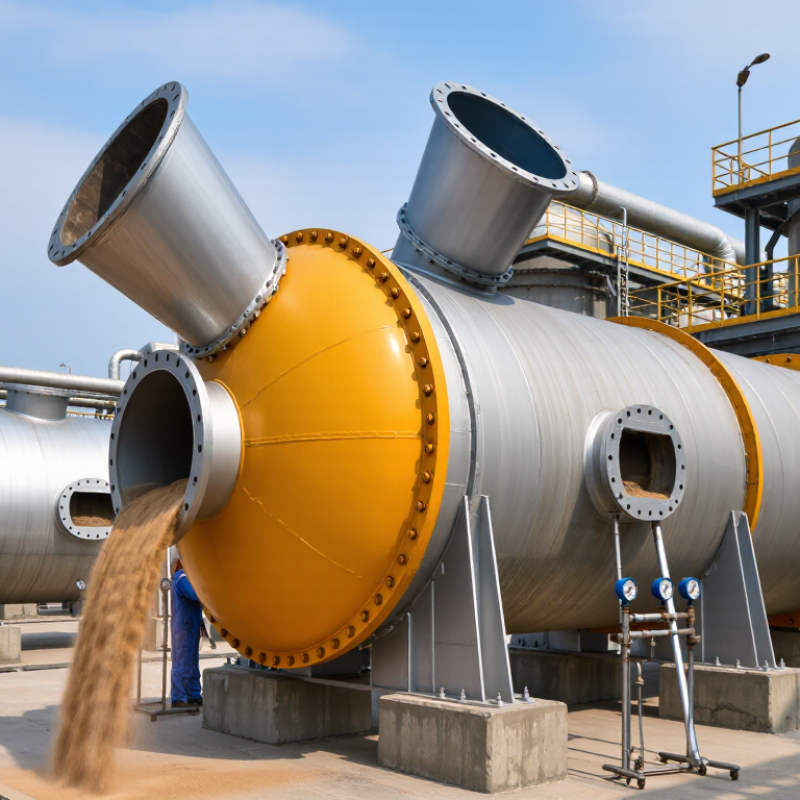
A China cyclone desander is a compact device used to remove sand, grit, and other dense solids from water or process fluids. It usually has no internal moving parts. This makes the unit simple to inspect and practical for demanding sites.
The fluid enters through a tangential inlet. This creates a strong spinning flow inside the cyclone chamber. Centrifugal force pushes heavier particles toward the wall, while cleaner liquid moves upward through the outlet. Separated solids fall into a collection chamber or discharge valve. The result depends on inlet pressure, particle size, liquid viscosity, and correct equipment sizing.
From field experience, installation details matter as much as the vessel itself. A pressure gauge before and after the desander can reveal clogging or poor flow conditions. The inlet pipe should remain reasonably straight, and the collection chamber needs regular cleaning. A catalogue capacity may look impressive, but it can mislead when the actual sand concentration differs. Buyers should request test data, material specifications, pressure ratings, and drawings before approval. Stainless steel may suit corrosive water, while coated carbon steel can reduce cost in less aggressive conditions. No cyclone desander removes every particle. Very fine clay may pass through, and unstable pump pressure can reduce separation efficiency.
What Is a China Cyclone Desander and How Does It Work?
| Evaluation Dimension | Technical Fact or Typical Range | Why It Matters in Selection | Global Buyer Verification Point |
|---|---|---|---|
| Basic separation principle | A cyclone desander uses centrifugal force. The feed enters tangentially, creating a high-speed vortex. Dense solid particles move toward the wall and exit through the underflow, while the cleaner liquid leaves through the overflow. | The equipment removes suspended sand and other dense particles without a filter element or moving internal parts. | Confirm the supplier has provided a process flow diagram showing the inlet, overflow, underflow, pressure gauges and solids collection arrangement. |
| Primary solids removed | Common targets include sand, grit, scale fragments and other relatively dense inorganic particles. Separation is governed by particle size, density, shape, liquid viscosity and operating conditions. | Hydrocyclones are most effective when the solids are denser than the liquid and the feed contains limited fibrous or sticky material. | Request a feed analysis including particle-size distribution, solid density, concentration, liquid viscosity and expected peak solids loading. |
| Indicative cut-size range | Many industrial hydrocyclone applications are designed for a separation target roughly within 10–75 micrometres, although actual performance can be coarser or finer depending on cyclone geometry and operating pressure. | A smaller target particle size normally requires a suitable cyclone diameter, adequate pressure differential and careful process design. | Do not compare cut-size figures without checking the test conditions, particle density, liquid properties, recovery definition and pressure differential. |
| Typical pressure differential | A pressure drop of approximately 0.5–2.0 bar is common for many desanding systems, but the actual value depends on cyclone size, flow rate, inlet pressure and required separation efficiency. | Pressure differential supplies the energy needed to form the vortex. Excessive pressure loss can increase pumping cost and reduce available downstream pressure. | Check the guaranteed operating pressure, maximum allowable pressure, design temperature and pressure-drop curve at minimum, normal and maximum flow. |
| Single-cone configuration | One cyclone body handles the process stream. It has a relatively simple layout, fewer valves and straightforward maintenance access. | Suitable for stable flow rates, compact installations and systems where continuous operation is not essential during cleaning. | Confirm the available flow range and determine whether a bypass or standby unit is required for uninterrupted service. |
| Multi-cyclone configuration | Several smaller cyclone elements operate in parallel inside a common vessel or skid. Flow is divided among the elements. | Often preferred when the system needs a wider operating range, higher capacity or a more compact pressure-vessel arrangement. | Verify flow distribution, minimum number of active elements, isolation-valve arrangement and the procedure for replacing an individual element. |
| Vertical vessel arrangement | The cyclone vessel is installed vertically, with solids normally collected at the lower section and separated liquid discharged through the upper outlet. | It can reduce the footprint and simplify gravity-assisted solids collection when sufficient overhead and foundation height are available. | Check total installed height, lifting requirements, drain clearance, foundation loads and access for inspection. |
| Horizontal skid arrangement | Cyclone vessels, valves, gauges and piping are mounted on a horizontal frame. The layout can be configured for transport and modular installation. | Useful where overhead space is restricted or where the buyer wants a preassembled package for faster site installation. | Confirm skid dimensions, dry and operating weight, lifting points, nozzle orientation, drainage and container or truck transport limits. |
| Solids discharge method | Common arrangements include a manual drain, collection chamber, automatic dump valve, rotary valve or a downstream solids-handling package. | The discharge system must prevent excessive solids accumulation and should not interrupt the required liquid flow. | Specify solids volume, discharge frequency, hazardous-area requirements, valve actuation, fail-safe position and operator access. |
| Liquid and process compatibility | Carbon steel, stainless steel and corrosion-resistant alloys may be used according to the liquid chemistry, temperature, pressure and erosion risk. | Material selection affects service life, maintenance frequency and compliance with the process safety requirements. | Submit the fluid composition, chloride level, pH, temperature range, pressure, erosion conditions and required corrosion allowance before quotation. |
| Internal wear protection | High-velocity sand can erode the inlet, vortex finder, cone and underflow section. Wear-resistant liners or replaceable inserts may be used in severe service. | Wear protection is particularly important for abrasive solids, high solids concentration and continuous operation. | Ask for the expected wear life, liner material, replacement procedure, spare-parts list and inspection intervals. |
| Flow control and instrumentation | A practical package may include inlet and outlet pressure gauges or transmitters, differential-pressure monitoring, isolation valves, drains and a solids-level indicator. | Stable pressure and flow improve separation consistency and help identify plugging, erosion or abnormal solids loading. | Confirm instrument ranges, connection standards, signal type, calibration documents, enclosure rating and any hazardous-area certification. |
| Filtration relationship | A cyclone desander is a pre-treatment device rather than a direct replacement for every filter. It reduces the bulk solids load before fine filtration, membranes or sensitive equipment. | Using a desander upstream can reduce filter cleaning frequency and protect pumps, valves, heat exchangers and membrane systems. | Define the downstream equipment protection limit and verify whether a polishing filter is still required for fine particles. |
| Best-fit applications | Common applications include well-water treatment, irrigation water, industrial process water, cooling-water pretreatment, mining slurry service and produced-water handling. | The best configuration depends on flow stability, solids characteristics, available pressure and the required level of automation. | Match the design to the actual process rather than selecting only by inlet and outlet pipe size. |
| Main advantages | No filter media, no routine backwashing media replacement, compact separation chamber, low moving-part count and continuous operation when the solids discharge is properly designed. | These characteristics can lower routine maintenance for streams containing heavy, free-flowing mineral solids. | Compare total operating cost, including pumping energy, valve maintenance, wear parts, solids disposal and instrumentation. |
| Main limitations | Performance decreases when particles have a density close to the liquid, when solids are very fine, when the feed is highly viscous or when fibrous and sticky material causes blockage. | A cyclone is not universally suitable for every solids-removal problem and may require a screen, filter, clarifier or other treatment stage. | Require a process calculation or pilot test for difficult feeds and ask for clear separation-efficiency limits rather than general claims. |
| Recommended buyer documents | General arrangement drawing, process data sheet, pressure-vessel documentation where applicable, material certificates, welding records, hydrostatic test report, coating specification, operating manual and spare-parts list. | Complete documentation supports installation, customs clearance, commissioning, maintenance and local regulatory review. | Agree on applicable standards, inspection points, language, document format, factory acceptance testing and warranty conditions before purchase. |
| Practical definition of “best” | The best cyclone desander is the configuration that meets the required solids-removal target at the available flow, pressure, temperature, material-compatibility and automation conditions. | Lowest purchase price alone does not establish the best technical or lifecycle choice. | Compare verified performance, pressure loss, wear life, documentation, serviceability, delivery capability and total cost of ownership. |
It is a compact device for removing sand, grit, and dense solids from water or process fluids. It usually has no moving parts. That makes inspection simpler.
Fluid enters through a tangential inlet and begins spinning inside the chamber. Centrifugal force pushes heavier particles toward the wall. Cleaner liquid rises through the outlet, while solids fall into a collection chamber.
Flow rate, inlet pressure, particle size, liquid viscosity, and solids concentration all matter. Stable pressure supports better separation. A unit rated for 100 m³/h may perform poorly at 40 m³/h.
The d50 value is the particle diameter removed at about 50% efficiency. Smaller cut sizes usually require greater pressure loss. Very fine clay may pass through.
Request flow ranges, pressure ratings, pressure-drop curves, material details, and temperature limits. Also request drawings and drain connection sizes. Test conditions should include particle size and concentration.
Stainless steel may suit corrosive water and abrasive service. Coated carbon steel can reduce cost in less aggressive conditions. Material choice should match water chemistry and expected wear.
Keep the inlet pipe reasonably straight and maintain suitable flow conditions. Install pressure gauges before and after the unit. These gauges can reveal clogging or unstable operation.
Clean the collection chamber regularly and inspect internal surfaces for wear. Replaceable liners can simplify repairs. Maintenance needs vary, and I would not trust a fixed schedule blindly.
Compare measured performance, not catalogue capacity alone. Check results across roughly 50–110% of rated flow. A slightly larger cone may cost more initially, but undersizing can cause frequent cleaning.
No. It cannot remove every particle. Fine clay, irregular particles, and fluctuating pump pressure can reduce efficiency. That limitation is easy to overlook.
A Cyclone Desander is a solid-control device that uses centrifugal force to separate sand and other dense particles from liquid streams. Its performance depends on key technical specifications, including flow capacity, pressure range, particle-removal efficiency, inlet and outlet design, construction materials, wear resistance, and compatibility with the intended fluid. For global applications, buyers should compare not only separation results but also adaptability to different operating conditions, safety requirements, climate environments, and project standards.
When selecting a supplier, global buyers should review manufacturing capabilities, quality-control procedures, testing documentation, customization support, delivery reliability, and after-sales service. Installation should include correct orientation, suitable piping, secure connections, and adequate space for inspection. During operation, stable flow and pressure should be maintained to prevent inefficient separation or excessive wear. Regular maintenance should cover inspection of liners, nozzles, valves, seals, and collection areas, with timely replacement of worn parts. A well-matched Cyclone Desander can improve process stability, reduce maintenance risks, and support dependable long-term performance.
